Guest blog post by Anaïs George, doctoral researcher at Halle
Researching the Medingen Manuscript O3 at Keble College
In February 2026, I had the opportunity to spend two weeks as an academic visitor in Oxford, working with Henrike Lähnemann. Like many researchers before me, I was drawn to the city by a manuscript. Yet one could equally say that I was following Saint Maurice, the patron saint of the convent of Medingen, to Oxford. One of the central sources for my doctoral research is a devotional text for his feast day, preserved in a manuscript held at Keble College Library under the shelfmark MS 18. Known by the siglum O3 among the Medingen Manuscripts, it belongs to a group of prayer books written by the nuns of Medingen at the end of the fifteenth century. The small-format manuscript (12 × 8.5 cm) consists of two parts, the second of which is dedicated to Saint Maurice. The aim of my visit was to verify and complete my transcription of this as yet unedited text by working directly with the manuscript.
Visiting Keble College Library
At the end of my first week in Oxford, the doors of Keble College Library were finally opened to us after Henrike Lähnemann had kindly put me in touch with the librarian. By that point, we had become something of a small manuscript expedition team. The librarian, Leona Stewart, had already prepared everything, and the manuscript was waiting for us.
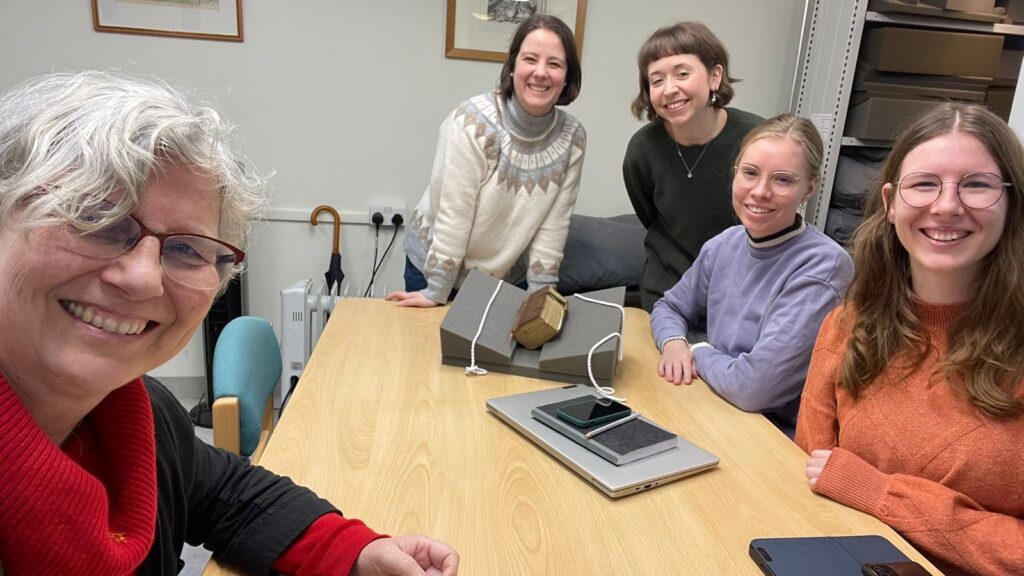
As an introduction, Henrike gave an impromptu overview of the Medingen manuscripts in general and, in particular, of the provenance history and significance of the prayer book O3, which has a fascinating backstory. The manuscript was written around 1490 by Mechthild Elebeke, a nun in the northern German Cistercian convent of Medingen. In the devotional text for the feast day of her personal patron apostle, Thomas, Mechthild refers to herself in abbreviated form as M. el. (O3, fol. 119r). She came from an influential family from Lüneburg and entered the convent of Medingen before 1480 together with her two sisters, Tiburg and Elisabeth. All three Elebeke sisters are listed in the two surviving indulgence letters from Medingen – the Turkish Indulgence of 1481 and the Compostela Indulgence of 1505.
Not only Mechthild but also her sisters wrote prayer books for their personal use. Their books contain both a group of prayers for the feast day of their respective personal patron apostle (Tiburg: St Matthias; Elisabeth: St Bartholomew) and one for the feast day of their shared convent patron, Saint Maurice. Fortunately, the nuns’ prayer books survived the Reformation in the sixteenth century and remained at Medingen until they were sold in the eighteenth century by the abbess as “superfluous costly objects” in order to finance new convent buildings. The manuscripts of Tiburg and Elisabeth eventually found their way to the Hamburg State and University Library, where they are preserved today as Ms. in scrin. 206 (= HH3, Tiburg Elebeke) and Ms. in scrin. 209 (= HH6, Elisabeth Elebeke). Mechthild’s book was sold to Henry Liddon, then Vice-Principal of St Edmund Hall and later a benefactor of Keble College. Leona Stewart explained that further manuscript digitisation projects are currently being planned at Keble College Library. This naturally raises the hope that O3 might also be digitised in the near future – not only for its preservation, but also in order to make this remarkable witness to late medieval female devotion accessible to a wider scholarly community. A digitisation of O3 would complement the already digitised manuscripts of Mechthild’s sisters Tiburg and Elisabeth and enable a comprehensive joint study of all three sister manuscripts.
The Saint Maurice Devotional Text in O3
The manuscript O3 written by Mechthild is remarkable in several respects. It stands out from the manuscripts of her sisters through its artistic design. In addition to elaborate initials with fleuronnée decoration and spray borders (Fig. 2), Mechthild’s manuscript also contains three bas-de-page miniatures and two historiated initials (Fig. 4–6). Furthermore, her text is the longest and most extensively structured according to the liturgical hours of all surviving Medingen devotional texts for the feast day of Saint Maurice.
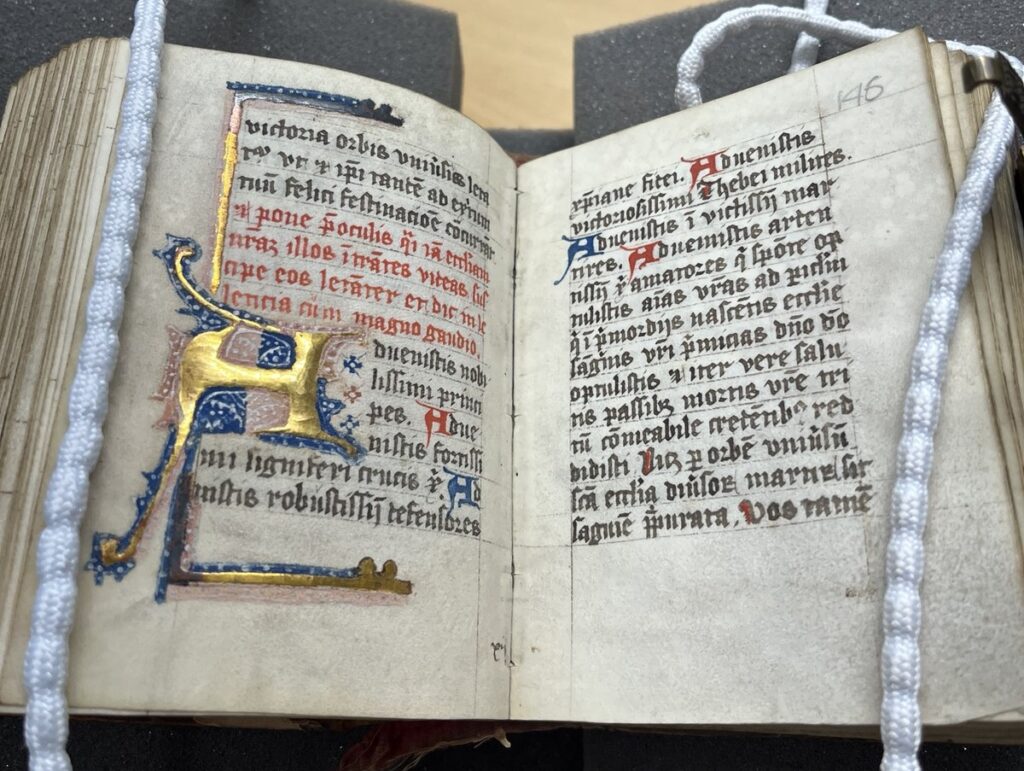
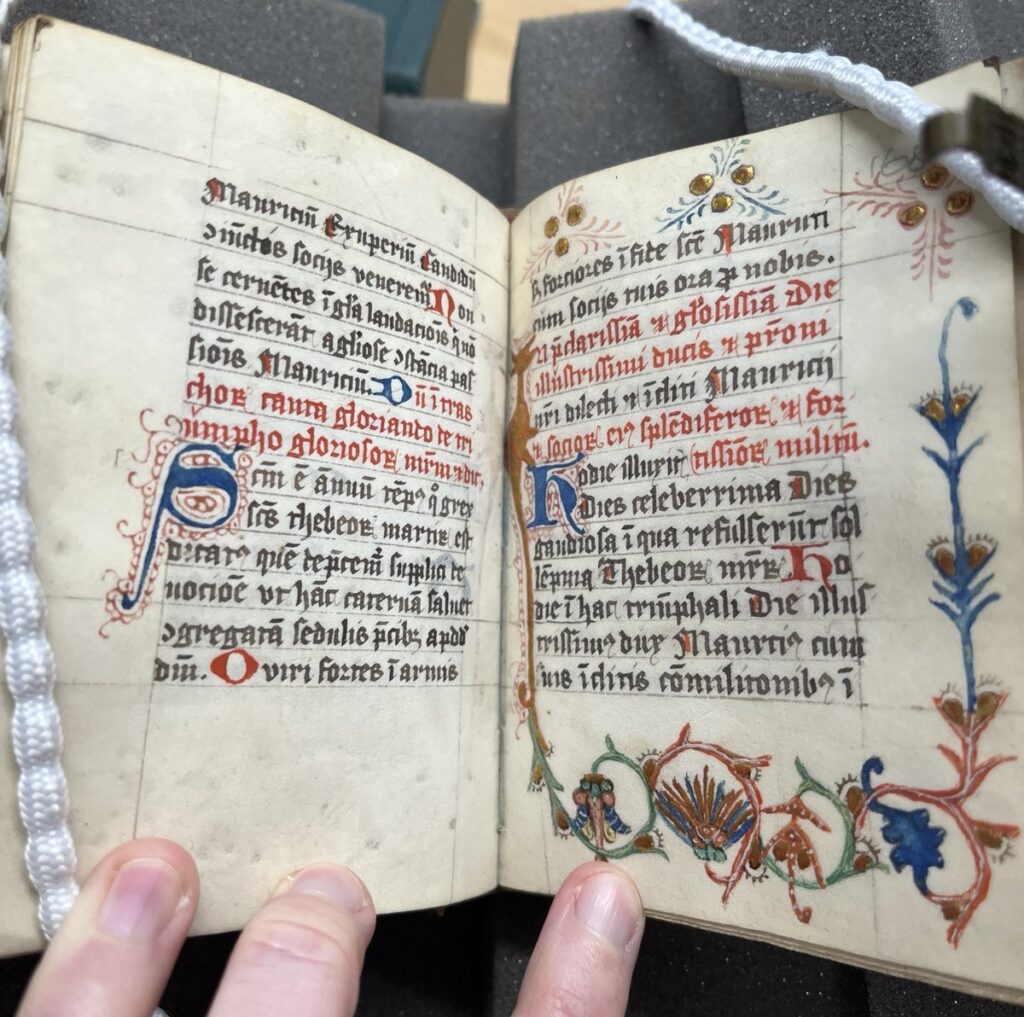
Figure 2: O3, fol. 145v-146r and fol. 167v–168r © Keble College Library (Photo: Anaïs George)
The devotional text accompanies the complete celebration of the feast of Saint Maurice – from the vigil through the feast day itself, with its liturgical hours, High Mass, and meals, to the octave of the feast (O3, fol. 131v–251v). Maurice and his legion are presented almost as honoured guests who are present within the convent community throughout their feast day. During First Vespers of the vigil, Mechthild welcomes Maurice and his companions of the Theban Legion with the repeated exclamation Advenisti (‘You have come’, O3, fol. 145v–146r; Fig. 2). The nun(s) then ‘spend’ the entire day together with their patron saint in prayer, devotion, and meditation.
Throughout the text, liturgy and devotion are closely intertwined. This is especially evident during the High Mass on the feast day, where the standard liturgy of the Mass is combined with devotions specifically tailored to Saint Maurice. Prayers and meditations accompany individual liturgical elements such as the Gloria, the Gospel, sequences, and the Preface. Only during Communion does the focus shift briefly and entirely to Christ. During the meals and subsequent liturgical hours, attention once again centres on Maurice as patron and protector of the convent of Medingen. Throughout the devotional text, he is invoked not only as a heavenly martyr but above all as the protector of the convent, its benefactors, and its entire familia.
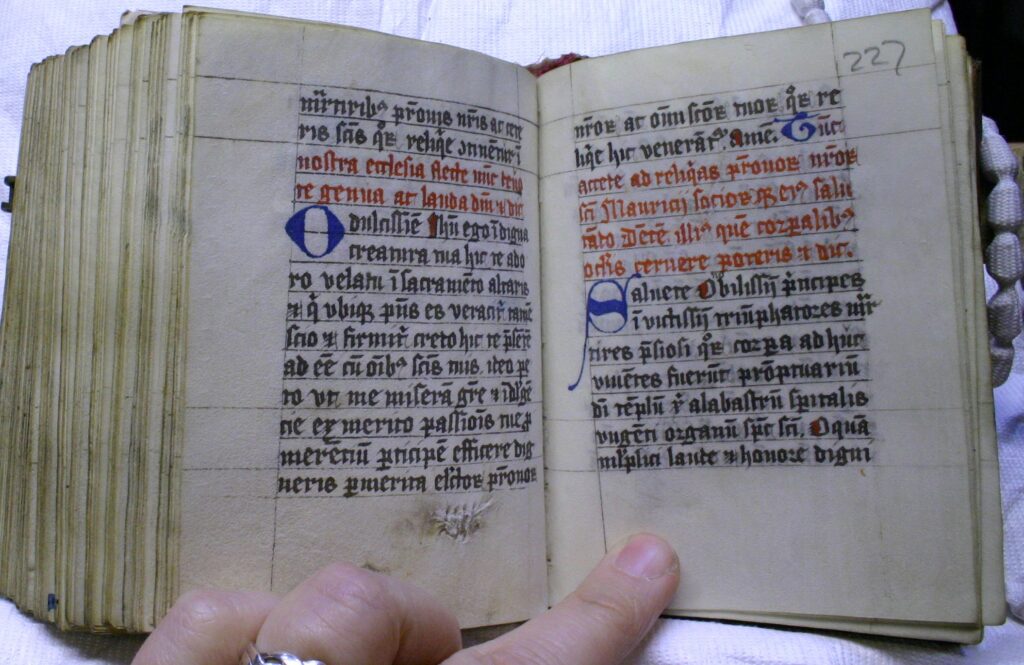
Figure 3: O3, fol. 226v–227r © Keble College Library (Photo: Henrike Lähnemann)
Particularly revealing is a feast-day devotion that addresses a relic (O3, fols. 227r–228r; Fig. 3). With the words Tunc accede ad reliquias patronorum nostrorum sancti Mauricii sociorumque eius salutando Dentem illius quem corporalibus oculis cernere poteris (‘Then approach the relics of our patrons, Saint Maurice of Agaunum and his companions, and greet his tooth, which you can behold with bodily eyes’), the text refers to a tooth relic of Saint Maurice. The instruction that the tooth can be seen corporalibus oculis suggests that the relic was physically present at Medingen and could be viewed by the nuns. Mechthild’s devotional text thus provides a rare and remarkably concrete reference to a specific relic of Saint Maurice at the convent. At the end of the feast day, Mechthild describes the farewell to the saint and his companions during Compline with remarkable emotional intensity, comparing it to the parting of parents and children. Yet even after the feast day itself has ended, devotion to the patron saint continues throughout the octave, keeping the memory of Saint Maurice alive beyond the feast itself.
The Illustrations in O3
Working directly with the manuscript enabled me to gain a better understanding of Mechthild’s system of abbreviations, punctuation, as well as the layout and rhythm of the manuscript. My repeated visits to Keble College Library therefore advanced my transcription considerably. At the same time, it was naturally a particular highlight to be able to study the miniatures and historiated initials of O3 in person. The Thomas section contains a historiated initial depicting the Apostle Thomas with a sword (fol. 37r) and three bas-de-page miniatures (Fig. 4): Thomas being sent to India by Christ (fol. 7r), Thomas in a boat on his voyage to India (fol. 55v), and Thomas distributing food (fol. 100r).
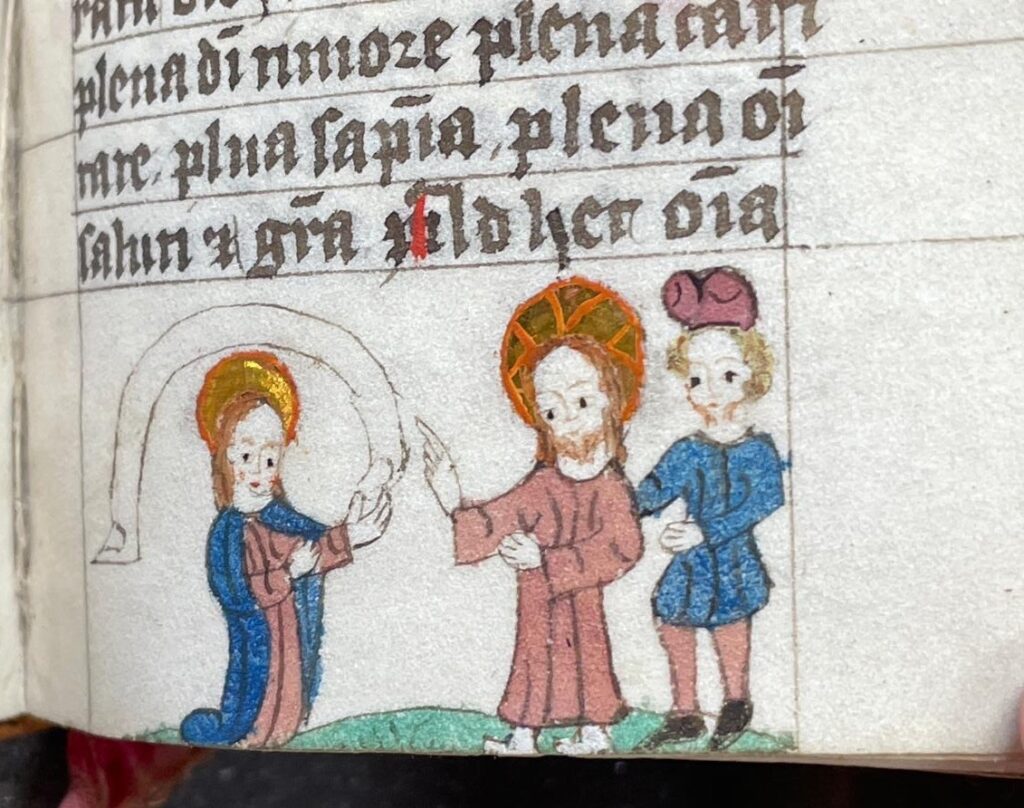
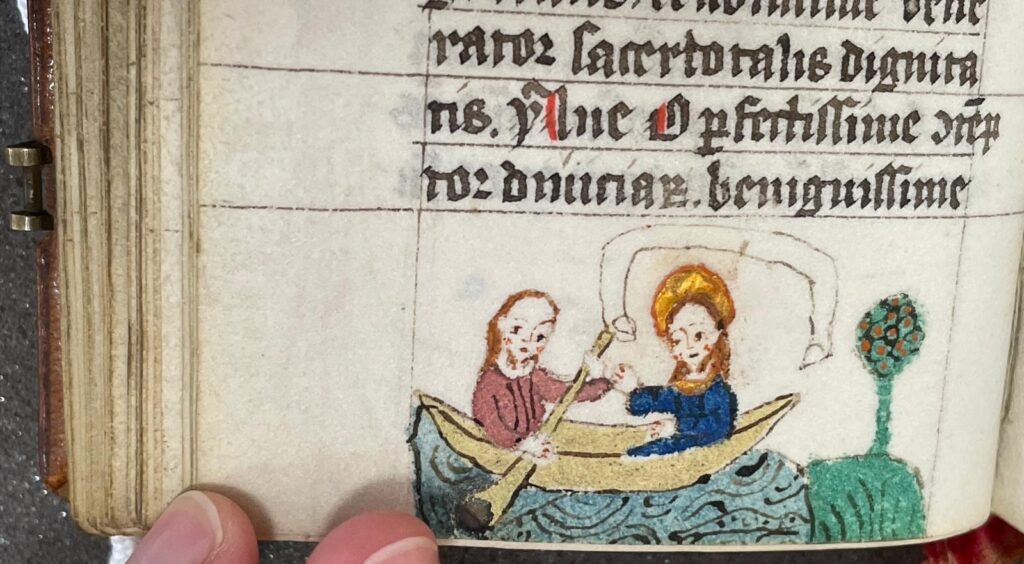
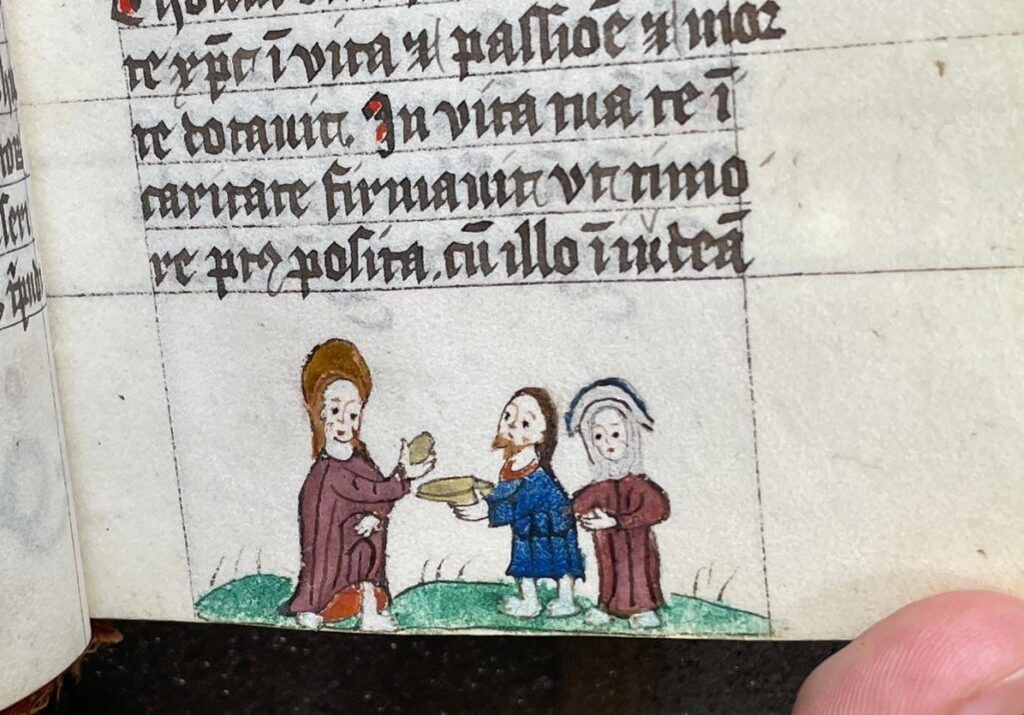
Figure 4: O3, fol. 7r, fol. 55v and fol. 100r © Keble College Library (Photo: Henrike Lähnemann)
In comparison, the Maurice section contains ‘only’ one historiated initial, yet it is highly impressive through its use of polished gold and silver and the precision of its details (fol. 201v; Fig. 5). Maurice is depicted at the very moment before his martyrdom. He is depicted in shining gold and red armour, kneeling before his execution by a Roman soldier whose sword has already been raised. Behind the executioner stands the Roman Emperor Maximian, richly dressed and issuing the fatal command. Beneath the arch of the gold-painted letter G, above a band of clouds, numerous small naked figures can be seen, representing the souls of Maurice’s companions from the Theban Legion who have already been martyred. Nestled above the upper arch of the letter G are two angels waiting to receive Maurice into heaven. Floral vine ornament emerges above and below the initial, framing the entire written space of the page.
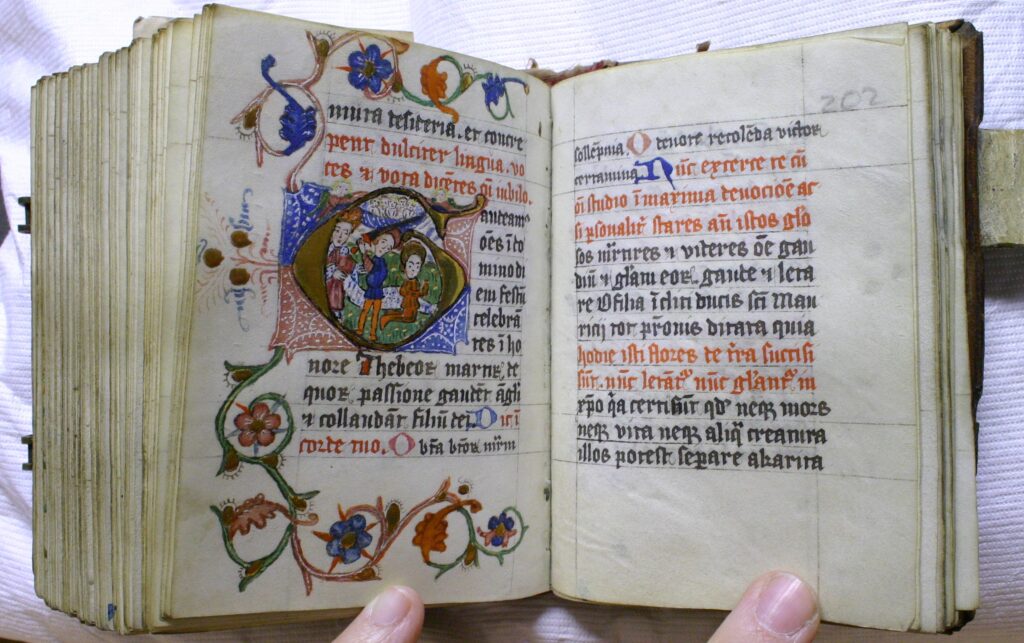
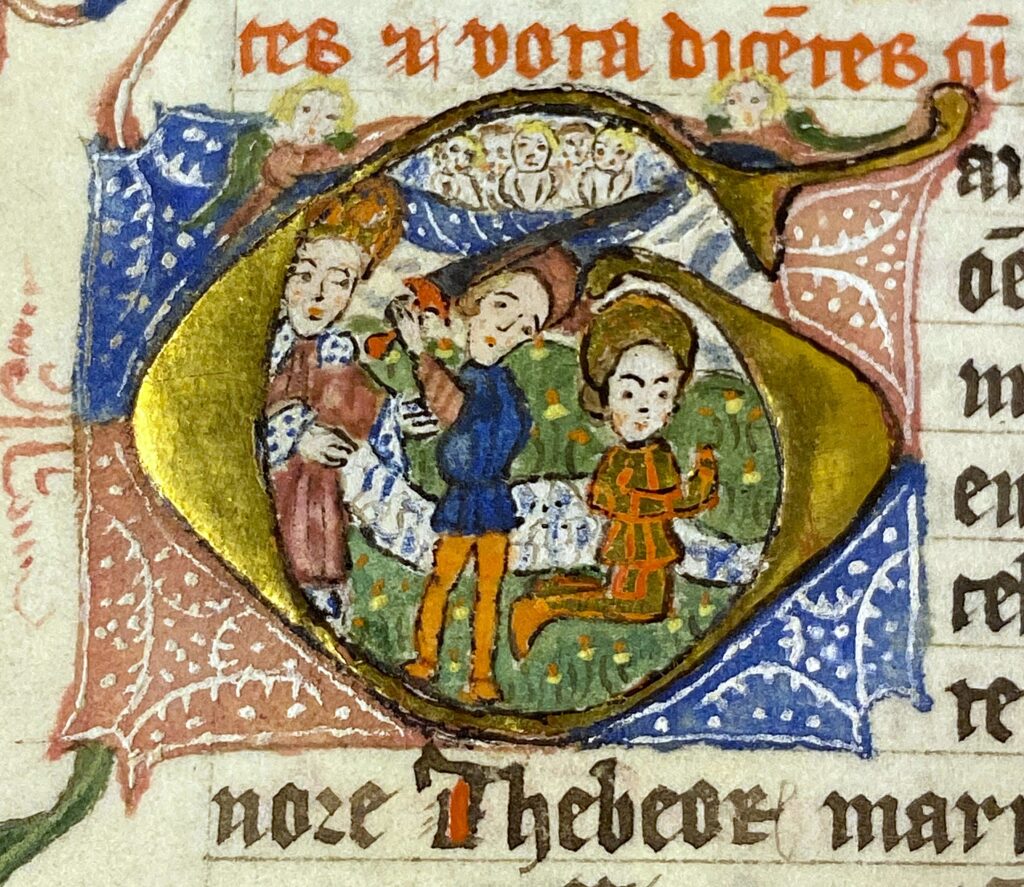
Figure 5: O3, fols 201v–202r and Detail of the Saint Maurice Initial © Keble College Library (Photo left: Henrike Lähnemann; Photo right: Leona Stewart)
Seeing these details directly on the parchment made clear how materially and visually these prayer books were experienced and how much effort Mechthild invested in her manuscript. They were not merely texts to be read, but spiritual companions carried between cell and choir, used regularly and experienced with all the senses. The prayer books of the Medingen nuns and the texts they preserve offer exceptional insights into late medieval female devotional practice.
Beyond the Manuscript
Of course, life in Oxford did not consist solely of libraries, manuscripts, and the various medieval studies seminars I attended. I had originally planned to explore the city by bicycle, but as Britain experienced one of the wettest periods since records began in early 2026, Oxford’s double-decker buses quickly became my preferred means of transport. The gloomy weather, however, did not prevent me from discovering Oxford and the university. I was warmly welcomed into the academic community and had the opportunity to meet many wonderful people during my two weeks there. On my very first evening, I attended Evensong in the chapel of St Edmund Hall (“Teddy Hall”), followed by a Formal Dinner. Thanks to Henrike’s impressive wardrobe collection, I was at least reasonably appropriately dressed when I accompanied her to High Table, which was certainly another highlight of my stay. At weekends, I visited the East Oxford Farmers’ Market, attended a wonderful concert at Exeter College, and visited a palace near Oxford together with two other academic visitors. Looking back, these two weeks brought together what I had hoped for: scholarly exchange, fascinating manuscripts, hospitality, and the privilege of being able to work directly with an extraordinary medieval object.
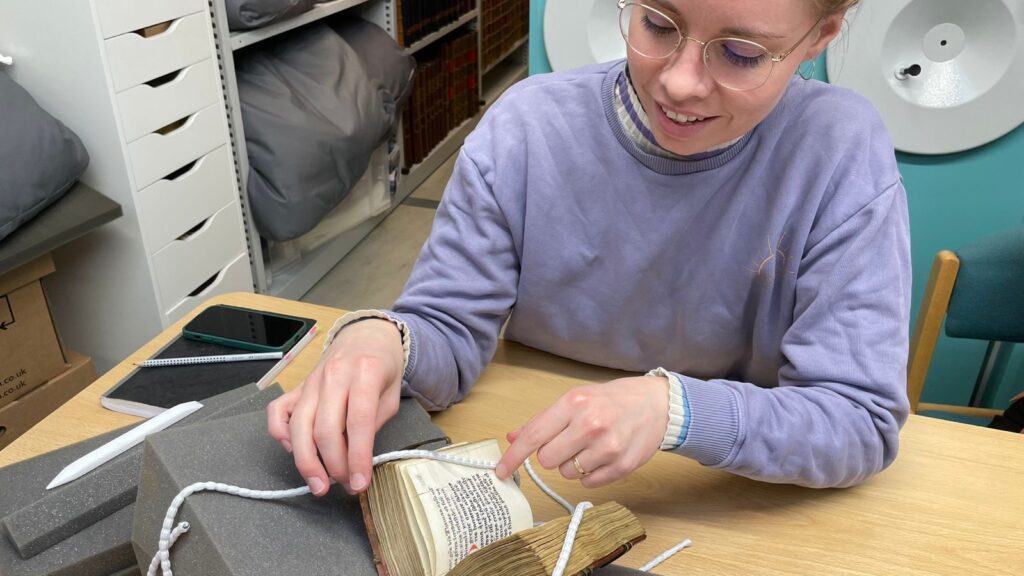
Figure 6: Working on the manuscript © Henrike Lähnemann
Bibliography
Gluchowski, Carolin. “‘Verschenkt, veräußert, vermakuliert?’: Die Handschriften aus dem Zisterzienserinnenkloster Medingen im Spiegel des langen 15. Jahrhunderts.” Jahrbuch der Gesellschaft für niedersächsische Kirchengeschichte 123 (2025): pp. 81–141.
Lähnemann, Henrike. “Handschriftenproduktion im Kloster: Das Beispiel Medingen.” In Schatzhüterin: 200 Jahre Klosterkammer Hannover, ed. Katja Lembke and Jens Reiche, pp. 182–187. Dresden, 2018.
Lähnemann, Henrike. “The Materiality of Medieval Manuscripts.” Oxford German Studies 45 (2016): pp. 121–141.
Lähnemann, Henrike. “Saluta apostolum tuum: Apostelverehrung in Kloster Medingen.” In Weltbild und Lebenswirklichkeit in den Lüneburger Klöstern, ed. Wolfgang Brandis and Hans-Walter Stork, pp. 41–64. Berlin: Lukas, 2015.
Lähnemann, Henrike. “Medinger Nonnen als Schreiberinnen zwischen Reform und Reformation.” In Rosenkränze und Seelengärten: Bildung und Frömmigkeit in niedersächsischen Frauenklöstern, ed. Britta-Juliane Kruse, pp. 37–42. Wolfenbüttel, 2013.
Lähnemann, Henrike. “Also do du ok: Andachtsanweisungen in den Medinger Handschriften.” In Text und Normativität (XX. Anglo-Deutsches Colloquium), ed. Franz-Josef Holznagel and Elke Brüggen, pp. 437–453. Berlin, 2012.
Author bio
Anaïs George is a doctoral researcher at Martin Luther University Halle-Wittenberg. Her dissertation examines the veneration of the patron saints Alexander and Maurice in the Lüneburg convents of Wienhausen and Medingen. The project combines foundational research on the textual sources relating to the two patron saints with questions of saintly cults, patronage, and devotional practice as reflected in the textual and visual evidence from the two convents. This blog post is based on a research stay at the University of Oxford in February 2026 and her work on O3, the Medingen manuscript preserved as MS 18 at Keble College Library.