Book Alert: The volume Medinger Handschriften in Hamburg. Neue Ansätze zur Erforschung der Andachts- und Handschriftenkultur, herausgegeben von Katrin Janz-Wenig und Henrike Lähnemann on new insights into the Medingen manuscripts held at the Staats- und Universitätsbibliothek Hamburg is currently undergoing final editorial checks before going into production.
Look forward to a volume of new contributions on the materiality of the manuscripts, collection history, a survey of the research of the last two decades, palaeographical analysis, literary discussions, and the addition of further volumes to the collection!
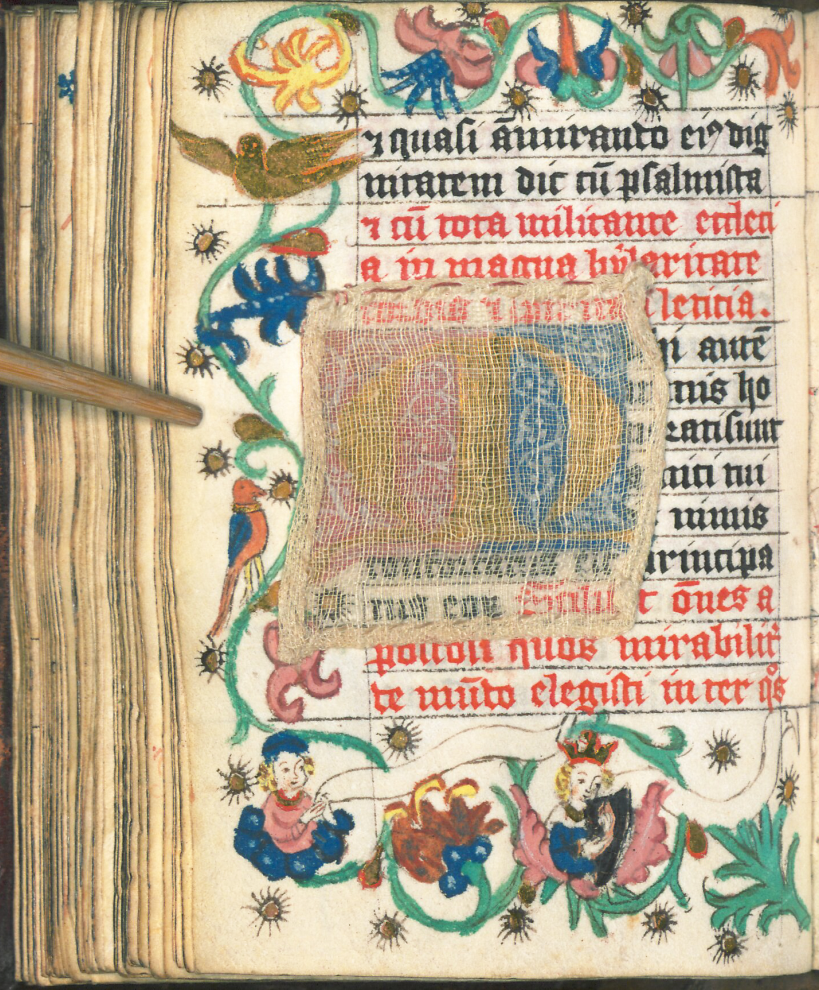
For more background information, read the original Call for Papers about the start of the project. To understand the header image, enjoy a blog post Veiling the Sacred by Mina Miyamoto with a preview of some of the veils she will share in her article. To see some the length to which some authors went to find new material for their article, consult the post Following Saint Maurice to Oxford by Anaïs George which also will be expanded in her contribution to the volume.
Abstracts
Henrike Lähnemann: New Approaches to the Study of Medingen Devotional and Manuscript Culture – An Introductory Research Overview
The introduction considers the period since the 2007 exhibition, focusing on new research approaches and the expansion of the corpus of Medingen manuscripts, their increased visibility, and the emergence of new types of prayer books such as those devoted to personal apostles as patron saints. In discussing the expansion of the holdings, it examines how new attributions and acquisitions of manuscripts became possible. All manuscripts now located in the United States were only claimed for Medingen after the exhibition: Michigan/Gethsemane, Harvard, Yale, Williams College; in addition, manuscripts in London, Cambridge, Stralsund, Weimar, and Utrecht; Oxford, Harvard, and Wolfenbüttel have since acquired manuscripts that were only in this context attributed to the convent.
Milestones since the Hamburg exhibition include a large number of workshops and research collaborations in which Medingen material has been incorporated: from the SNF-funded project Medienwandel und Medienwissen (Zug/Switzerland 2008), Materialität in der Editionswissenschaft (Berlin 2008), the exhibition on Lower Saxon women’s convents Rosenkränze und Seelentrost (Wolfenbüttel 2013), and the Klosterkammer exhibition Schatzhüterin (Hanover 2018), workshop conferences such as Reading Books as Cultural Objects (Freiburg 2015), the Ebstorf colloquia on Passion and Easter in the Lüneburg convents and others on convent life and music (Ebstorf 2009/2011/2013), meetings at Lüne on Middle Low German and the Lüne letter books, the series of meetings at Wienhausen on fragments organised by Simone Schultz-Balluff, Mysticism, Art and Devotion between Late Medieval and Early Modern (Antwerp 2011), several conferences of the Verein für Niederdeutsch with a medieval focus (Göttingen 2012, Stendal 2016), the Anglo-German medievalist colloquia on Norm and Normativity (Bonn 2007) and Dichtung und Didaxe (Nottingham 2013), Re-Use and Re-Cycling (Oxford 2022), and convent reforms (Hamburg 2024).
New research approaches enriched by this expansion of material include iconographic studies (for example on post-Easter appearances of Christ or representations of nature), work on multilingualism and code-switching, and digitalisation projects that have opened up new perspectives on the manuscripts. In addition, book-historical and material approaches have brought manuscript biographies into focus, highlighting the processual character of manuscripts repeatedly reworked within the convent, and situating them within a broader context of related materials (Lüne letter books, Wienhausen fragments, etc.). In this way, they are newly defined as expressions of a late medieval–early modern interface of devotional culture.
Wolfgang Brandis: Medingen in the Context of the Lüneburg Convents – A Historical Introduction
This contribution examines, from the perspective of an archivist, the role of Medingen within the context of the Lüneburg convents and traces its development from its beginnings in the thirteenth century to the present day. The starting point is Medingen’s integration into the political and ecclesiastical structure of the Principality of Lüneburg and into the network of the six convents that still exist today. It analyses the conditions of foundation, monastic affiliation, and the complex relationships with episcopal and territorial authority.
A central focus lies on the transformation of monastic life in the late Middle Ages, particularly in the course of the reform movements of the fifteenth century, which led to a stronger orientation towards the Rule of St Benedict and an intensification of spiritual and cultural practice. At the same time, the importance of material and written transmission, such as the Medingen manuscripts and the pictorial cycle of the convent’s history, is emphasised.
The introduction of the Reformation in the sixteenth century appears as a profound rupture, marked by considerable resistance on the part of the convents. The article examines how economic pressure and territorial interventions ultimately led to their transformation into Protestant foundations, without entirely breaking institutional continuity. For the modern period, particular attention is given to the rebuilding after the fire of 1781, changes in the social structure of the convents, and their increasing openness to the public and to scholarship. Overall, the contribution demonstrates the remarkable continuity of the Lüneburg convents as religious, cultural, and social institutions that have endured despite profound upheavals and continue to exist to this day.
Hans-Walter Stork: “Von Frauenhand” and the Formation of a Medingen Corpus
The contribution examines the prehistory of the Hamburg cabinet exhibition “Von Frauenhand – Medieval Codices from the Convent of Medingen in the Hamburg State and University Library” (4 September to 14 October 2007) and the presentation of the manuscripts, which, due to their small format, are difficult to display. The trigger was a digitisation initiative through which the corpus of the five apostle prayer books was first recognised as such. These Medingen apostle prayer books, produced by the nuns themselves, exhibit a distinctive script and style of illumination that is characteristic of late medieval northern German convents and sets them apart from the products of other contemporary scriptoria. Together with two Easter prayer books already attributed to Medingen, the Hamburg manuscripts formed a core group whose characteristic selection of texts and images made it possible to recalibrate the entire corpus.
A central analytical focus lies on the specific script of the Medingen manuscripts, especially the deliberately archaising textura, which has repeatedly led to misdating. The contribution interprets these retrospective writing habits in the context of monastic reform movements as an expression of “renewal through remembrance”, which can also be observed in other scriptoria. It further reconstructs production conditions and networks of actors: the role of individual scribes, the organisation of monastic writing processes, and the interaction between in-house production and the external acquisition of manuscripts and incunabula.
Andres Laubinger: Medingen Manuscripts – Perspectives on an XML-Based Database
The article outlines essential steps for the digital cataloguing of a complex body of transmission using the Medingen manuscripts, from the perspective of 2007, when the first pilot digitisation projects were available. This allows for historical benchmarking against which developments such as IIIF and the large-scale digitisation of the Hamburg Medingen manuscripts can be evaluated. Earlier publications of Medingen manuscripts exemplify very different approaches: while Mante’s edition of the Trier Easter prayer book (T1) stands firmly within the tradition of editorial philology, the digital presentation of HHL1 in Harvard represents the manuscript in its physical form and colour. This can be framed as a contrast between evidence and interpretation, and between materiality and referentiality. Their integration can be achieved through a digital edition that unites image and text.
Suitable tools already existed in Shared Canvas and TextGrid. Based on open standards and XML derivatives, especially TEI guidelines, such environments allow for multiple hierarchical structuring of manuscript contents. Additional possibilities arise from integrating further standards such as NeumesXML and MusicXML for musical notation, CANTUS IDs for identifying chants, and Iconclass classifications for describing images. In principle, the use of standards greatly facilitates the editorial process, ensures data persistence, and allows for detailed and flexible representation. Technically, implementation should rely on a non-relational, document-oriented database containing the full text of all Medingen manuscripts.
Starting from the digitised edition of Mante as a pragmatic basis, parallel passages in other manuscripts could be gradually transcribed, bringing together dispersed texts virtually. With appropriate metadata and an accessible interface, such a database could generate dynamic text versions and enable complex searches. Since 2007/2008, a preliminary version has existed online; its further development should incorporate advances in digital humanities and the “network turn.”
Katrin Janz-Wenig: The Medingen Manuscripts from the Collection of Johann Melchior Goeze – Reflections on Provenance and Collection History
The Medingen manuscripts formerly owned by Johann Melchior Goeze (1717–1786) provide, to a certain extent, insights into the collecting profile of an early modern theologian. Among other things, the article offers an expanded list of the surviving manuscripts from Goeze’s collection and reconstructs the ways in which he acquired books and manuscripts. It also seeks to reconstruct the pathways through which these books and manuscripts were acquired. The discussion further considers the history of what are today the Library’s Manuscript and Special Collections, highlighting the cultural and historical shifts in the perception and evaluation of medieval manuscripts. The article thus contributes to our understanding of the reception of medieval manuscripts and their appraisal and use in the early modern period.
Johann Melchior Goeze, Senior Pastor of St Catherine’s Church in Hamburg, was a staunch defender of Lutheran orthodoxy. Today, however, he is perhaps better known for his fierce polemics against Gotthold Ephraim Lessing. Goeze was also one of the most important collectors of Bibles in his time. His collection reflects his self-conception as a scholar who worked with and through his books, appropriating them as intellectual tools and companions in his research.
Following his death, Goeze’s Bible collection was transferred intact to the Hamburg City Library, the predecessor of today’s Hamburg State and University Library. Tragically, the greater part of this valuable collection was destroyed during the Second World War. Only a small number of items survived, most notably the medieval manuscripts he had assembled. Unlike the printed books, these manuscripts had been evacuated from Hamburg in 1943 and remained safely stored throughout the war. Recent examinations of the manuscript holdings of the Hamburg State and University Library have made it possible to identify additional volumes that can be securely attributed to Goeze’s collection.
Beate Braun-Niehr: The Medingen Psalter in Berlin and the Production of Psalters in the Cistercian Convent – Liturgy and Devotion during the Late Medieval Reform
The psalter Ms. theol. lat. oct. 189 (BE1) of the Berlin State Library was produced during the reform of the Medingen convent under Provost Tilemann von Bavenstedt. Obiit entries in the liturgical calendar show that the manuscript was passed down over two generations among nuns from the Lüneburg family Witick. The second and third owners were daughters of Beata Witick, whose Easter prayer book is preserved in Hamburg (HH1). In the early eighteenth century, the manuscript was initially in private ownership before entering the Royal Library in Berlin in 1908 via the Salzwedel Gymnasium Library.
Computistical tables and texts precede the psalter section, which is enriched with invitatories and antiphons according to the cursus monasticus and is supplemented by Old and New Testament canticles, the Te deum, and the Athanasian Creed. Extracts from the Cistercian rites of death and burial, with notated chants, as well as prayers to the convent’s patron Saint Maurice and to the patron saints of Lüneburg, Michael and John the Baptist, conclude the codex, which was probably bound in a Lüneburg workshop.
The manuscript’s decorative programme is particularly noteworthy. Gold fleuronnée initials mark the beginnings of the matins psalms according to the monastic division, as well as the Te deum and the prayer to Saint Maurice. By contrast, historiated initials in colour on gold grounds, common in private psalters since the High Middle Ages, highlight the psalms according to the threefold and eightfold divisions (cursus Romanus). Small scenes, individual figures, and extended banderoles in the margins complement the pictorial programme, for which numerous iconographic parallels can be identified within the Medingen tradition. The Beatus initial, featuring the Tree of Jesse and the Madonna with a Radiant Crown, introduces a Vita Christi cycle focusing on the Nativity, Passion, and Easter. This cycle is interrupted at Psalm 38 by two representations of the Evangelist John. His veneration as the personal patron of the original owner is also indicated by unusual feast days in the calendar.
Whereas at the time of the 2007 Hamburg conference only the closely related psalter Ms I 96 in Hanover (HV4) could be compared with the Berlin manuscript, the numerous new discoveries of Medingen manuscripts now provide a much broader comparative basis. The juxtaposition with the psalters in Cambridge (CA3), Göttingen (GT4), Oxford (O4), and a fragmentary psalter in Yale (Y) aims not only to demonstrate common features of these reform-era manuscripts but also to highlight the distinctive aspects of the Berlin codex.
Anja Peters: Adaptation and Personalisation – The Reworking of the Decoration of a Psalter in Medingen
This article examines an extraordinary psalter, SUB Hamburg Cod. in scrin. 149. On stylistic grounds, the original manuscript can be located in the Thuringian-Saxon region of the thirteenth century. However, various additions and modifications attest to an extensive process of reworking carried out in Medingen in the second half of the fifteenth century.
Some of these alterations occurred at the textual level: while the psalms and canticles of the main body were retained, a new calendar was inserted at the beginning, and the Litany of All Saints at the end was partially rewritten to adapt feast days and saints to the convent’s practices. An appendix of prayers was also added. A substantial portion of the modifications, however, took place on the visual level: through the insertion of miniatures from different sources and numerous decorative elements, such as initials and foliate ornaments, cut from other manuscripts and pasted into the psalter text.
The article focuses on these visual modifications, positioning them within the historical context of Medingen during the period of reform. It begins by analysing the full-page miniatures in the heavily reworked first quire. A Crucifixion miniature, probably of South German origin, forms part of a Vita Christi cycle together with the original miniatures of the Annunciation and Nativity, which were carefully reinserted, and the historiated initials of the division psalms. At the same time, it is linked to the manuscript’s devotion to Saint John, most clearly expressed in a devotional image of the Evangelist with a small praying nun with the pointed veil characteristic of the Medingen habit after 1479.
The pasted-in initials and Lombard capitals from other manuscripts may have served to emphasise particular psalms. Especially noteworthy is a tiny inserted head of Christ in the initial of Psalm 50, which may have functioned as a focal point for the viewer’s devotion. The foliate ornaments added to some of the large psalm initials may even represent attempts to repair worn areas.
The careful reworking of the Hamburg psalter reveals a highly personal engagement with the manuscript by one or more Medingen nuns. Their creative adaptation of old, partly external, and new, locally produced material to create a personalised devotional book reflects both the convent’s requirements and the individual preferences of the nuns who used it.
Carolin Gluchowski: Curating the Cloud of Witnesses. The Medingen Apostle Prayer Books
This article examines the Medingen books of saints and apostles (Heiligen- und Apostelorationalien) as a distinct and hitherto only marginally explored type of devotional manuscript within late medieval religious culture, placing the Hamburg apostle prayer book HH3 (SUB Hamburg, Ms. in scrin. 206) at the center of analysis. Based on this manuscript, written and revised by the Medingen nun Tiburg Elebeke, it argues that apostle prayer books should not be understood as mere compilations of liturgical texts, but rather as complex, medially structured devotional media in which standardized liturgy, individual piety, and monastic community intersect in specific ways.
At the core of the study lies the observation of a dual movement: on the one hand, the texts draw on normed liturgical forms; on the other, they transform these into personalized devotional practices. This transformation is most clearly articulated through the veneration of the so-called personal apostle (Eigenapostel), who functions as an individualized patron saint and privileged mediator between the human and the divine. In HH3, this relationship becomes tangible in Tiburg’s self-fashioning as the “daughter” of her apostle Matthias, thereby constructing a form of “spiritual kinship” that intertwines individual expectations of salvation, monastic identity, and social order. The manuscript thus operates as a medium of a personalized economy of salvation, in which grace and the remission of sins are mediated through the personal apostle.
From a codicological and textual perspective, HH3 can be reconstructed as a dynamic structure composed in multiple layers and repeatedly revised. The manuscript consists of relatively autonomous textual units that were expanded, rearranged, and reframed over the course of its use. This practice points to an ongoing engagement of the nuns with their books, extending beyond the initial act of production to include continuous adaptation in response to changing devotional profiles. Apostle prayer books thus emerge as flexible objects of use that materialize both individual piety and institutional change.
A comparison with other Medingen manuscripts (e.g. HH5, LO4) as well as with prayer books from neighboring convents (Ebstorf, Wienhausen, Lüne) demonstrates that these manuscripts operate within a field of tension between standardization and personalization. While they draw on supra-regional patterns of saintly veneration—especially characteristic sequences of guardian angel, personal apostle, patron saint, and selected saints—these are condensed in Medingen into independent, book-length formats. The “Medingen heaven of saints” thus appears not as an isolated phenomenon, but as a convent-specific intensification of a widely shared devotional repertoire.
Methodologically, the article approaches apostle prayer books as “devotional technologies” that not only reflect but actively structure and produce religious practice. As performative media of grace and salvation, they enable a rhythmic structuring of monastic daily life and simultaneously function as media of female self-positioning: within them, the nuns present themselves as “learned brides of Christ” and “daughters of the apostles,” inscribing themselves into a multilayered order of heavenly, monastic, and familial relationships. In this sense, the article also understands the Medingen apostle prayer books as “social engineers.”
Finally, the study opens new perspectives on the genesis and dating of this group of manuscripts. The analysis of layers of revision, together with a reassessment of the puellae coronatae, suggests that parts of these apostle prayer books were already produced prior to the Medingen reform of 1479 and subsequently revised in the course of the reform process. The manuscripts thus emerge as dense witnesses to a longue durée process in which transformations of late medieval piety can be traced into the period of the Reformation.
The Medingen apostle prayer books may therefore be understood as a central “laboratory” of late medieval religiosity, in which questions of mediality, individualization, monastic normativity, and female agency converge in exemplary ways.
Lori Krukenberg: Witnesses to Liturgical Reform – The Hamburg John–Thomas Orational
The Bursfeld reform did not produce an abrupt liturgical rupture in Medingen but unfolded as a long-term negotiated process in which established chant practices were selectively reshaped rather than replaced. Prayer books produced before 1479 document a rich chant tradition, partly non-Cistercian, closely integrated into devotional practice and subjected to increased scrutiny during the visitation of 1479.
Although reform statutes formally required conformity to the Cistercian rite, a second visitation charter explicitly permitted certain exceptions, especially for chants associated with patron saints and thus also the convent’s patron apostles. As the analysis of Cod. in scrin. 208, dedicated to the apostles John and Thomas shows, the post-reform saints’ prayer books do not reflect simple compliance with normative regulations but rather a controlled continuity in which elements of the earlier repertoire were retained in reduced and visually altered forms. In the absence of normative chant books, these prayer books emerge as key witnesses to the ways in which liturgical song was adapted, curated, and gradually reoriented under the conditions of reform.
Mina Miyamoto: Function and Transparency of Textile Fragments in Medingen Manuscripts
Textile curtains are a feature of medieval manuscripts, attached to parchment pages to cover miniatures and initials. This practice has been documented in written sources since the early twelfth century in Scotland (Life of St Margaret by Turgot of Durham), but it is also found in manuscripts from the German-speaking world, particularly in psalters.
In the prayer books produced in Medingen in the fifteenth century, such curtains were frequently sewn over gold miniatures and initials. It is striking that the materials used vary widely: plain and patterned silk, linen, parchment, and paper. Equally noteworthy is the preference for transparent fabrics, as seen in the Bartholomew prayer book (SUB Hamburg Cod. in scrin. 209). Because some curtains are sewn very close to the spine and the books themselves are very thick, it can be assumed that they were most likely attached before binding, that is, during the production of the manuscripts.
This article analyses how different materials were used as textile curtains in Medingen manuscripts, why transparent fabrics were generally preferred, and what effect this transparency had during use.
Anaïs George: In preclarissima et gloriosissima die. The Feast Day of the Patron Saint Maurice in a Medingen Manuscripts in Hamburg
The article examines the veneration of Saint Maurice as the patron saint of the Cistercian convent of Medingen through an analysis of the extensive devotional text for his feast day preserved in the Medingen manuscript HH3, now held in the Hamburg State and University Library. Its point of departure is the observation that Maurice appears in a large number of the known Medingen manuscripts and thus occupies a central position within the convent’s cult of saints: seven of the nine Medingen manuscripts in Hamburg contain texts relating to the patron saint and thereby reflect exemplarily the significance of Maurice within the Medingen manuscript tradition.
After an introduction to the history of the veneration of Saint Maurice and the still unresolved origins of his patronage in Medingen, the extensive prayer section for the feast day of Saint Maurice in manuscript HH3 forms the central focus of the article. Its analysis provides insights into the late medieval devotional culture of the convent. The article investigates the structure, composition, and content of the devotional text as well as the relationship between liturgical elements and individual devotional material. It demonstrates that the texts combine the communal feast-day liturgy with prayers, meditations, and devotional instructions, thus enabling an individual appropriation of the veneration of Maurice.
Particular attention is paid to the functions of the patron saint within the monastic community. Maurice appears not only as a heavenly intercessor and spiritual helper, but also as the protector of the entire convent and its familia. The texts show that his veneration functioned as a source of communal identity and was closely connected with ideas of protection, care, and monastic community. A comparison with a Medingen apostle prayer text further reveals that the veneration of the patron saint was structurally connected to other devotional forms, while at the same time being expanded through the patron’s specific functions and responsibilities. The article thus contributes to the study of late medieval saint veneration and monastic devotional practice in the Lüneburg convents.
Marlene Schilling: Personifications in the Medingen Easter Prayer Books
This article analyses, from a literary-analytical perspective, the personifications of time in the Easter prayer books Ms. in scrin. 151b (HH1) and Ms. Cod. theol. 2199 (HH2). Addresses to a personified moment such as “Welcome, most noble and most joyful Easter day! You are the honour of all days” (Ms. Cod. theol. 2199, fol. 72r) are among the most characteristic features of Middle Low German prayer books for liturgical feasts of the church year: such a feast is joyfully welcomed by the speaking “I” of the text, personified, and endowed with positive attributes.
Using the function of the personification of Easter Day as an example, the article examines the rhetorical potential of these temporal personifications in prayers and defines the personification of Easter Day as a stylistic device for clarifying and manifesting the Easter miracle. The use of attributes of light and excellence, as well as characterisations of Easter Day as the moment of Christ’s Resurrection, highlight the close connection between the personification of Easter Day and the Easter miracle, extending even to an identification of Easter Day with Christ. Structural similarities between addresses to the personified Easter Day and addresses to Christ or the Virgin Mary elevate the Easter Day personification to the level of holy figures. Through the act of address and the associated personification of Easter Day, a particular and intimate relationship is established between the textual “I” and the feast day, along with all its salvific implications—something that could not be achieved through simple description. In this way, the personification of time also constructs the textual “I,” thereby sharpening the devotional profile of the Medingen community of nuns.
These findings on the function of the Easter Day personification as a manifestation of the Easter miracle are compared with results from analyses of other Medingen Easter prayer books, in order to situate the manuscripts of the Hamburg State and University Library within the broader tradition of the convent of Medingen.