Transparent Textile Curtains and the Experience of Revelation in Medingen Manuscripts
Mina Miyamoto
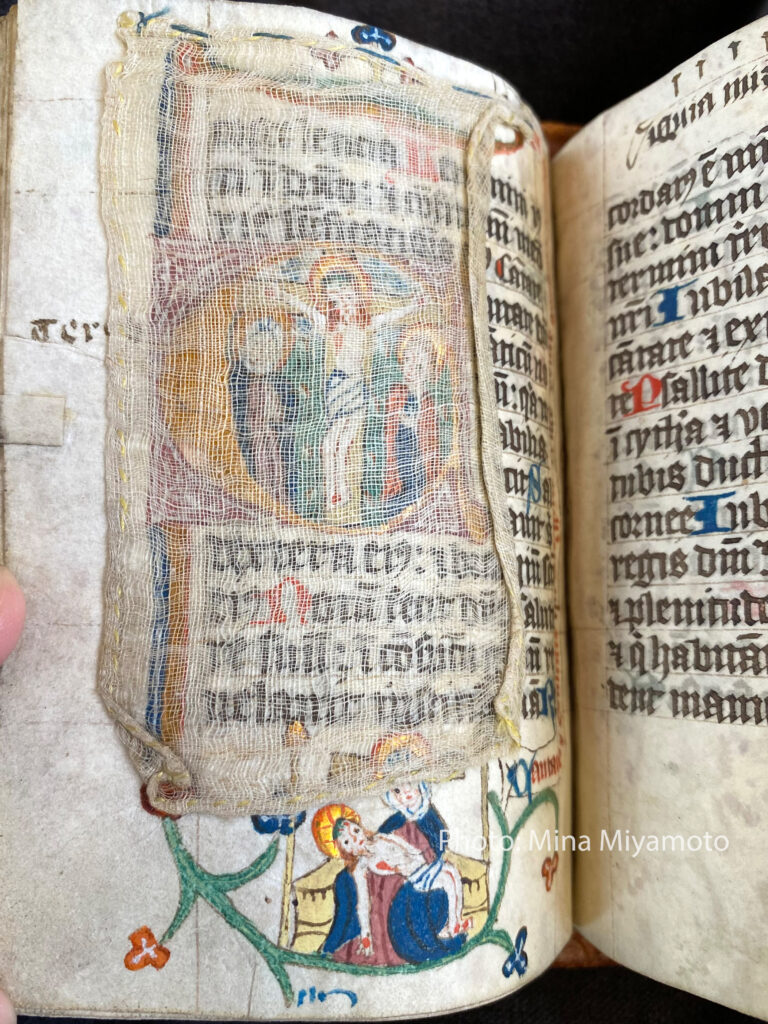
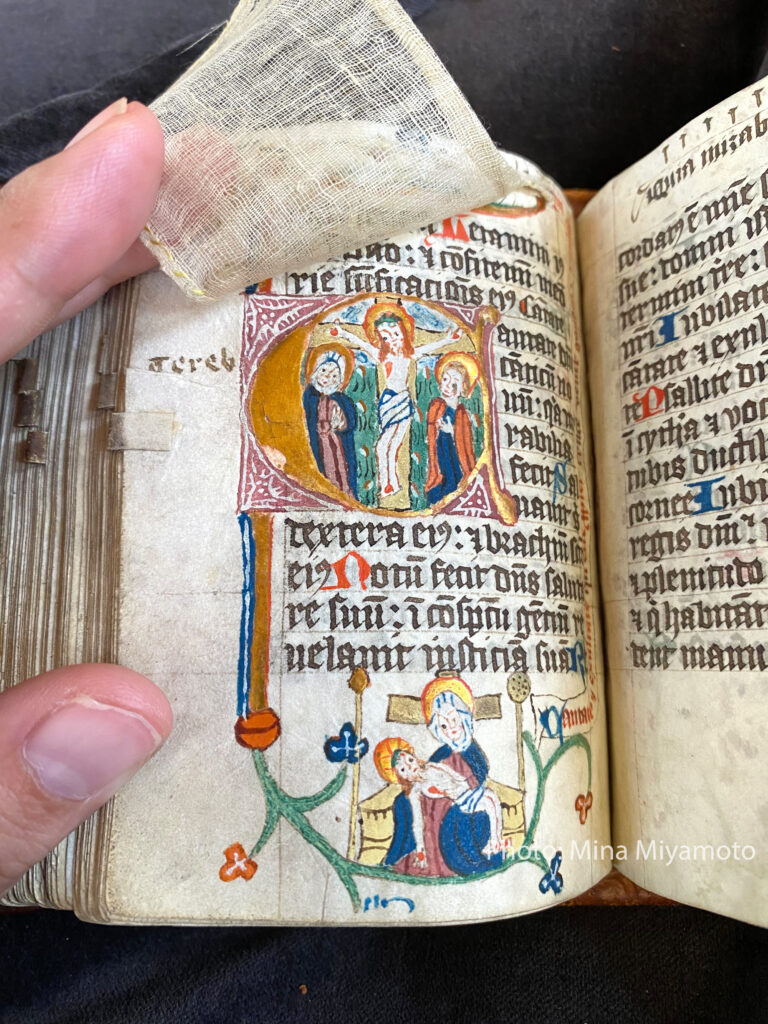
BE1, fol. 173v © Staatsbibliothek Berlin (Photo: Mina Miyamoto)
When I first began working on textile curtains in medieval manuscripts, I was struck by how easily they could be overlooked. Small, often fragile, sometimes barely visible, they sit quietly on the page. Yet the more closely I examined them, the clearer it became that they are not marginal at all. They are integral to how these books were made, used, and experienced.
In my recent research, I have focused on a group of manuscripts associated with the convent of Medingen. These manuscripts, primarily small-format devotional books from the fifteenth and early sixteenth centuries, provide an unusually rich corpus for studying textile additions. Out of 64 manuscripts, around half either still preserve textile curtains or show traces, such as stitch holes or thread remains, that indicate their former presence. This is not an isolated phenomenon; it is a consistent practice within this community.
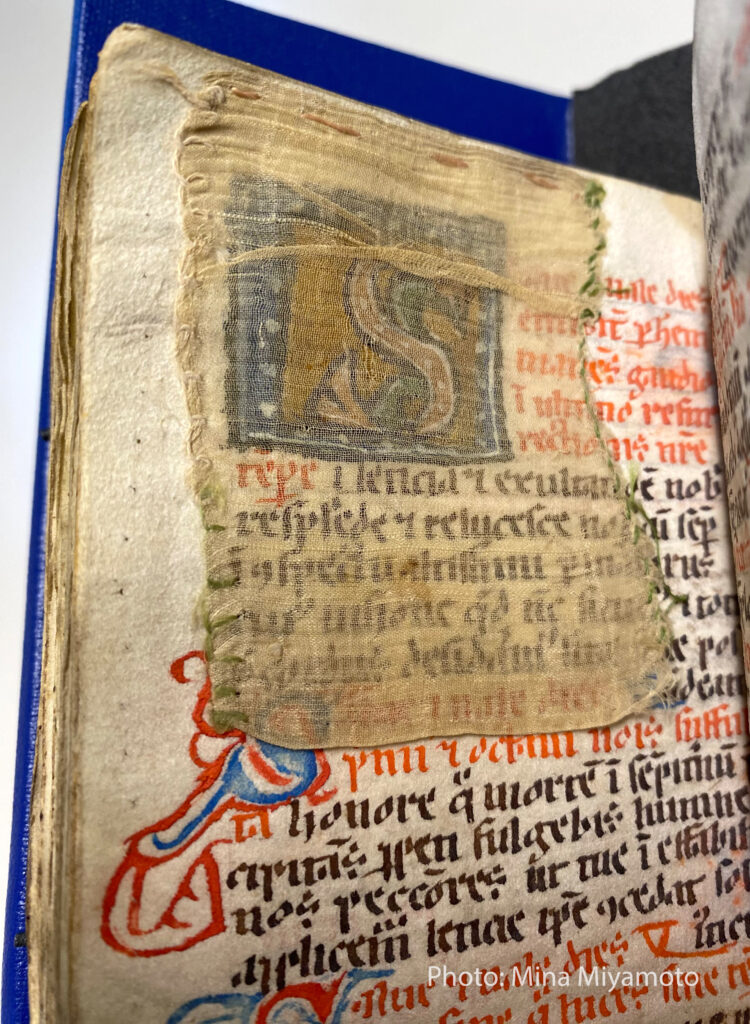
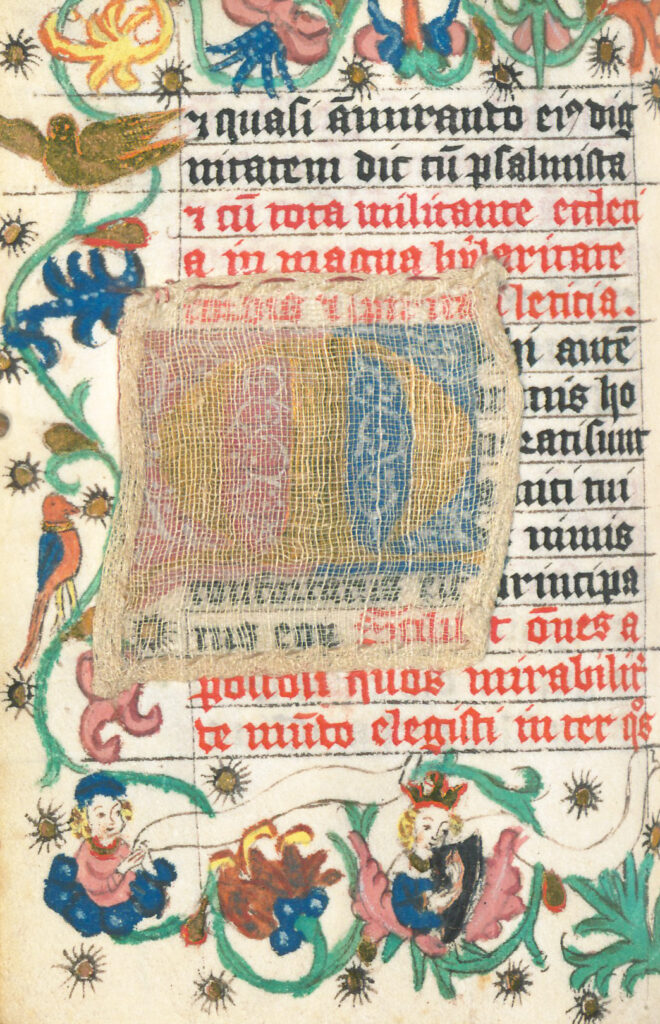
W6, fol. 69v © Herzog August Bibliothek Wolfenbüttel (Photo: Mina Miyamoto) / HH6, fol. 44v © Staats- und Universitätsbibliothek Hamburg
At a basic level, the function of these textile curtains seems straightforward. They were sewn onto parchment pages to cover decorated elements, especially gold initials and miniatures. The protective function is well documented. Already in the twelfth century, sources describe how precious manuscript pages were shielded by cloth to prevent damage through contact. This makes practical sense: gold and pigment are vulnerable, and repeated handling would inevitably cause wear.
However, as I examined the Medingen manuscripts more closely, I began to question whether protection alone could explain what I was seeing. The majority of textile curtains in this corpus are made of very fine, loosely woven fabrics, most often linen, that are strikingly thin and transparent. They are carefully cut to match the size of the decorated elements and neatly finished along the edges with coloured threads. Crucially, they do not fully conceal what lies beneath. The gold and imagery remain visible through the fabric.
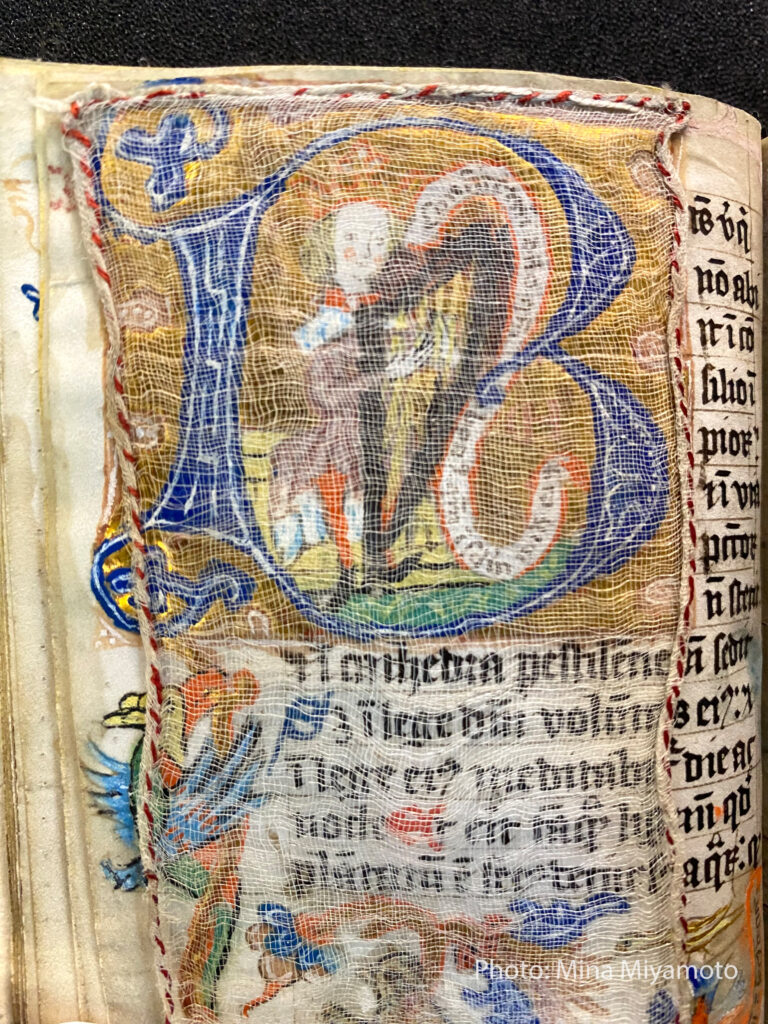
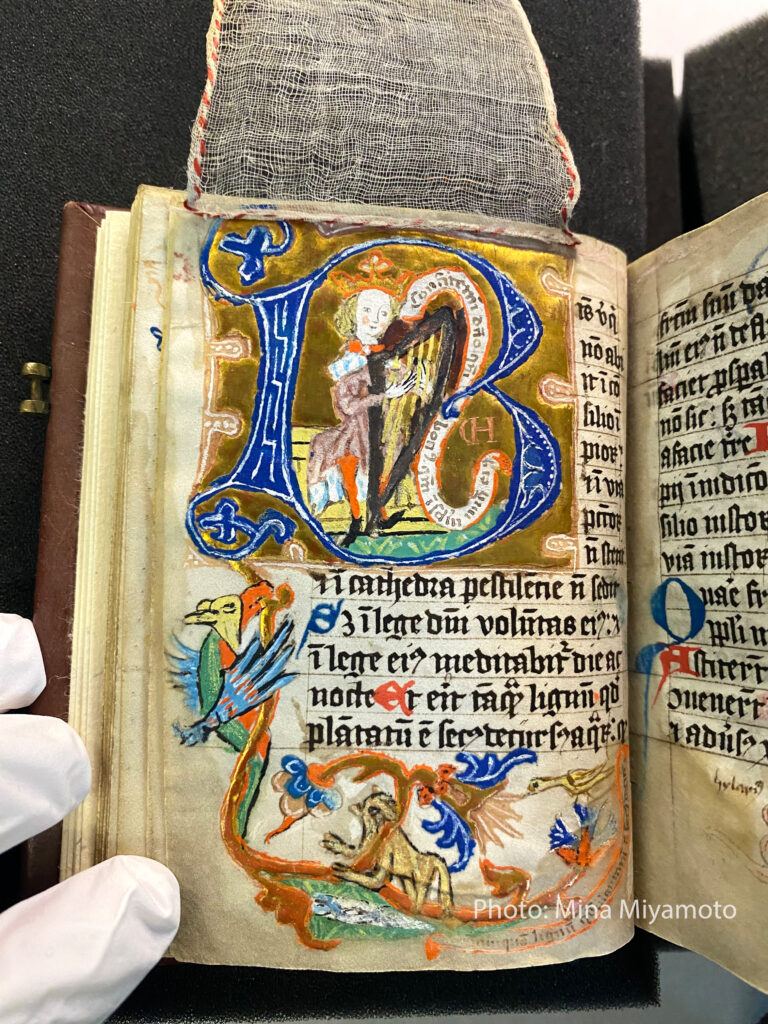
HV4, fol. 21v © Gottfried Wilhelm Leibniz Bibliothek – Niedersächsische Landesbibliothek Hannover (Photo: Mina Miyamoto)
This raises an important question: if concealment were the sole aim, why use transparent materials? In some manuscripts, we do find opaque coverings, such as paper, which completely block the underlying text or image until lifted. These examples demonstrate that full concealment was technically possible. The persistent use of translucent textiles, therefore, must have had a different rationale.
My approach has been to take the materiality of these curtains seriously. I have analysed not only the fabrics themselves, linen, silk, occasionally paper, but also their weave structures, stitching techniques, and methods of attachment. Most curtains are sewn along one edge, usually at the top or side, allowing them to be lifted and lowered. In some cases, their position near the binding suggests that they were attached before the book was fully assembled, indicating that they were planned as part of the manuscript’s original design.
These observations point to use. The textiles were not static coverings; they were meant to be handled. In some manuscripts, the edges of the fabric are visibly worn, suggesting repeated movement. This leads me to consider the role of these curtains within devotional practice.
The Medingen manuscripts are predominantly prayer books intended for private use, often connected to specific liturgical periods such as Easter. In this context, the act of covering and uncovering images may have been more than practical. It may have structured the reader’s engagement with the book. Lifting a textile veil to reveal a miniature or a gold initial could create a moment of heightened attention, a pause, an anticipation, a transition.
BE1, fol. 55r © Staatsbibliothek Berlin (Video: Mina Miyamoto)
The transparency of the fabrics adds another layer to this experience. Because the underlying image is never entirely hidden, the act of unveiling does not produce a simple shift from invisibility to visibility. Instead, it intensifies what is already partially perceived. Under the veil, gold and colour are muted but present; when the fabric is lifted, they emerge more fully. I find it difficult to imagine that this effect was accidental.
Lighting conditions would have played a significant role here. These manuscripts were often used in dim interiors, illuminated by candlelight. In such settings, gold surfaces respond dramatically to shifting light. A translucent textile would soften and diffuse this effect, while the act of lifting it would allow the gold to catch the light more directly. It is conceivable that this created a visual experience that was both subtle and powerful, one that reinforced the spiritual significance of the images.
This brings me to the question of meaning. In medieval thought, the interplay of concealment and revelation is deeply significant. Textiles, veils, and curtains are frequently associated with the idea of divine truth being hidden and then disclosed. The metaphor is well established in theological writing. When I consider the Medingen textiles in this light, I begin to see them not only as practical devices but as material participants in a broader symbolic framework.
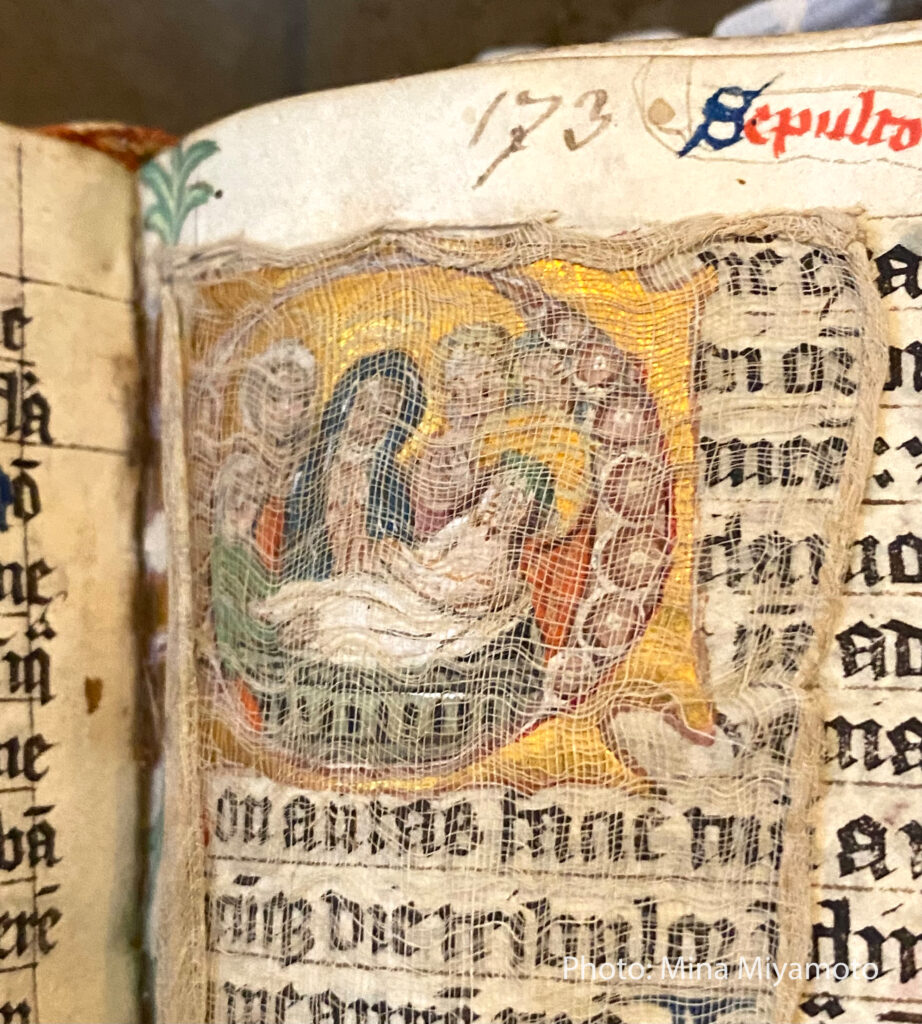
O1, fol. 173r © Bodleian Library Oxford (Photo: Mina Miyamoto)
At the same time, I remain cautious. The function and meaning of textile curtains are not uniform across all manuscripts. They depend on context: the type of book, its intended use, the period in which it was produced, and the materials available. In some cases, especially where dense or opaque fabrics are used, concealment may indeed have been the primary concern. In others, particularly where fine, transparent textiles dominate, additional layers of meaning seem likely.
Another aspect that interests me is production. The simplicity of many of the fabrics, especially the linen weaves, suggests that they could have been produced locally. Comparable materials appear in other textile works from women’s convents, such as embroidery grounds and liturgical textiles. It is therefore plausible that the nuns themselves not only used these manuscripts but also created and modified them, preparing and sewing the textile curtains onto the pages.
This possibility highlights the intersection of different forms of labour within the convent: writing, reading, sewing, and praying. The manuscript becomes a site where these activities converge. It is not merely a container for text but a composite object shaped by multiple practices.
One question that remains unresolved is why these textile curtains are so rarely depicted in contemporary images. Medieval paintings often represent books in great detail, including bindings and accessories, yet textile veils within manuscripts are almost never shown. This absence is striking, especially given how common the practice appears to have been. It suggests that certain aspects of manuscript use, perhaps those associated with private devotion, were not considered suitable for visual representation.
Ultimately, my research has led me to reconsider what a manuscript is. These textile curtains, small as they are, transform the book into a dynamic object. They introduce movement, tactility, and temporality. They invite the reader not only to look and read but also to touch, to lift, to reveal.
In this sense, they reshape the experience of the manuscript. The page is no longer a fixed surface but a layered space, in which visibility is controlled and modulated. The act of reading becomes, at least in part, an act of unveiling.
Bibliography
Adams, Morgan Simms. “Identifying Evidence of Textile Curtains in Medieval Manuscripts in the Morgan Library & Museum.” Suave Mechanicals: Essays on the History of Bookbinding, vol. 6, 2020, pp. 2–61.
Braun, Joseph. Die liturgischen Paramente in Gegenwart und Vergangenheit. 2nd ed., Herder, 1924.
Durandus, Wilhelm. Rationale divinorum officiorum, translated and annotated by Herbert Douteil, with an introduction, edited by Rudolf Suntrup, Teil 1, Aschendorff 2016.
Eberlein, Johann Konrad. Apparitio regis – revelatio veritatis: Studien zur Darstellung des Vorhangs in der bildenden Kunst von der Spätantike bis zum Ende des Mittelalters, Reichert 1982.
Ganz, David. Der Bamberger Psalter: Msc.Bibl.48, Staatsbibliothek Bamberg, Kommentar zur Faksimile-Edition, Quaternio 2019.
Klack-Eitzen, Charlotte, Wiebke Haase, and Tanja Weißgraf, editors. Heilige Röcke: Kleider für Skulpturen in Kloster Wienhausen. Schnell & Steiner, 2013.
Miyamoto, Mina. “Schutzfunktion oder mehr? Überlegungen zu transparenten Textil-Vorhängen im Vorauer Evangeliar (Stiftsbibliothek zu Vorau, MS 346).” In Libri voravienses. Studien zur Bibliothek des Augustiner Chorherrenstiftes Vorau, edited by Thomas Csanády and Erich Renhart, Graz, 2025, pp. 187–202.
Rudy, Kathryn M. Postcards on Parchment: The Social Lives of Medieval Books. Yale UP, 2015.
Schellewald, Barbara. “Hinter und vor dem Vorhang: Bildpraktiken der Enthüllung und des Verbergens im Mittelalter.” Hinter dem Vorhang: Verhüllung und Enthüllung seit der Renaissance – von Tizian bis Christo, edited by Claudia Blümle, Hirmer, 2016, pp. 124–131.
Sciacca, Christine. “Raising the Curtain on the Use of Textiles in Manuscripts.” Weaving, Veiling, and Dressing: Textiles and Their Metaphors in the Late Middle Ages, edited by Kathryn M. Rudy and Barbara Baert, Brepols, 2007, pp. 161–190.
Seeberg, Stefanie. “Verhüllen und Enthüllen unsichtbarer Geheimnisse: Textilien in der Ausstattung des Altars im Mittelalter” Hüllen und Enthüllungen. (Un-)Sichtbarkeit aus kulturwissenschaftlicher Perspektive, edited by Inga Klein, Nadine Mai and Rostislav Tumanov, Reimer 2017, pp. 204–226.
Spitz, Hans-Jörg. Die Metaphorik des geistigen Schriftsinns: Ein Beitrag zur allegorischen Bibelauslegung des ersten christlichen Jahrtausends. Fink, 1972.
Author bio
Mina Miyamoto is a researcher specialising in medieval manuscript studies and the study of medieval textiles. She has recently completed her doctorate on Textiles as Curtains in Medieval Manuscripts. This blog post forms the basis of a longer study to be published in the volume Medinger Handschriften in Hamburg (peer reviewed, under contract). Further information is available via the Herzog August Bibliothek: https://www.hab.de/mina-miyamoto/.